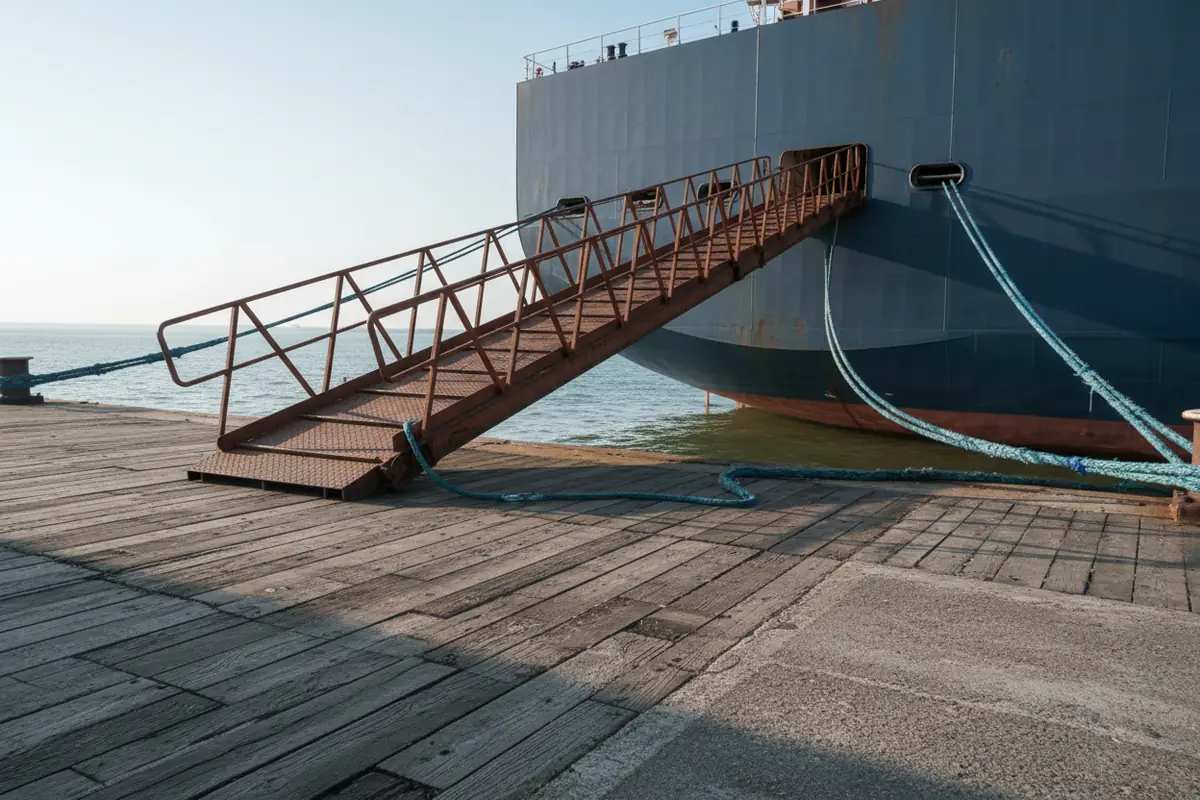
Which Law Applies When Someone Is Hurt at the Dock Edge
Three bodies of federal law do most of the work in dock injury cases, and each answers a different question. For an injured person, the practical stakes are which court can hear the case, whether benefits arrive without proving fault, and whether anyone can be sued for negligence.
The first is admiralty jurisdiction, meaning the power of federal courts to hear maritime cases under federal maritime law. Under 46 U.S.C. § 30101(a), that jurisdiction "extends to and includes cases of injury or damage, to person or property, caused by a vessel on navigable waters, even though the injury or damage is done or consummated on land." Federal district courts have original jurisdiction over civil maritime cases, "saving to suitors in all cases all other remedies to which they are otherwise entitled," under 28 U.S.C. § 1333. For someone hurt on a dock, this means the key fact may be what the vessel did, not where the person landed. It is worth thinking back on whether a moving hull, a shifting gangway or a line under load from the vessel played a part.
Whether the water counts as "navigable" matters because that word appears in both the jurisdiction rule and the Longshore Act. In plain terms, 33 C.F.R. § 2.36 generally treats as navigable the territorial seas, internal waters subject to tidal influence, and certain non-tidal internal waters that are or have been used, or are susceptible for use, as highways for substantial interstate or foreign commerce, or that a body with waterway-improvement expertise determines can be improved at reasonable cost for that use, except where Congress has designated otherwise. For many commercial docks this is not in dispute; on smaller inland waters it can be.
The second is the Longshore and Harbor Workers' Compensation Act, usually called the Longshore Act: a federal compensation system for maritime workers. If you were hurt on a pier rather than aboard the vessel, that does not by itself put you outside it. Under 33 U.S.C. § 903(a), except as otherwise provided in that section, compensation is payable for disability or death resulting from an injury "upon the navigable waters of the United States (including any adjoining pier, wharf, dry dock, terminal, building way, marine railway, or other adjoining area customarily used by an employer in loading, unloading, repairing, dismantling, or building a vessel)." The open question is often whether the job and the location both fit.
Not everyone is included. Under 33 U.S.C. § 902(3), the term "employee" does not include several groups, including a master or member of a crew of any vessel, and individuals employed by a marina who are not engaged in its construction, replacement or expansion (routine maintenance does not count as such work); that marina exclusion, like several others in the list, applies only if the person is subject to coverage under a state workers' compensation law.
The third is the Jones Act, 46 U.S.C. § 30104(a), under which "a seaman injured in the course of employment" may bring a civil action at law, with a jury, against the employer. A seaman, for this page's purposes, is a crew member of a vessel.
What a person may weigh next is simple to state: where they were standing, what the vessel was doing, and what their job was. Those three facts point toward one of these laws, and sorting out which one is a common starting point in a conversation with a maritime attorney.